


Thyroid blood tests show how your thyroid is functioning by measuring hormone levels and the signals that control them. A thyroid function test usually starts with TSH, while free T4 helps show whether your thyroid is producing enough hormone.
Abnormal test results don't establish a diagnosis on their own. Your symptoms, medicines, pregnancy status, and laboratory reference ranges all affect what your results mean.
Read the results together and discuss them with a healthcare professional.
Key takeaways
-
TSH and the unbound portion of thyroxine measure different parts of the same hormone-control system.
-
A result outside the reference range needs interpretation alongside your health history.
-
Supplements and medicine timing can affect accuracy, even when fasting isn't required.
How TSH and free T4 work together
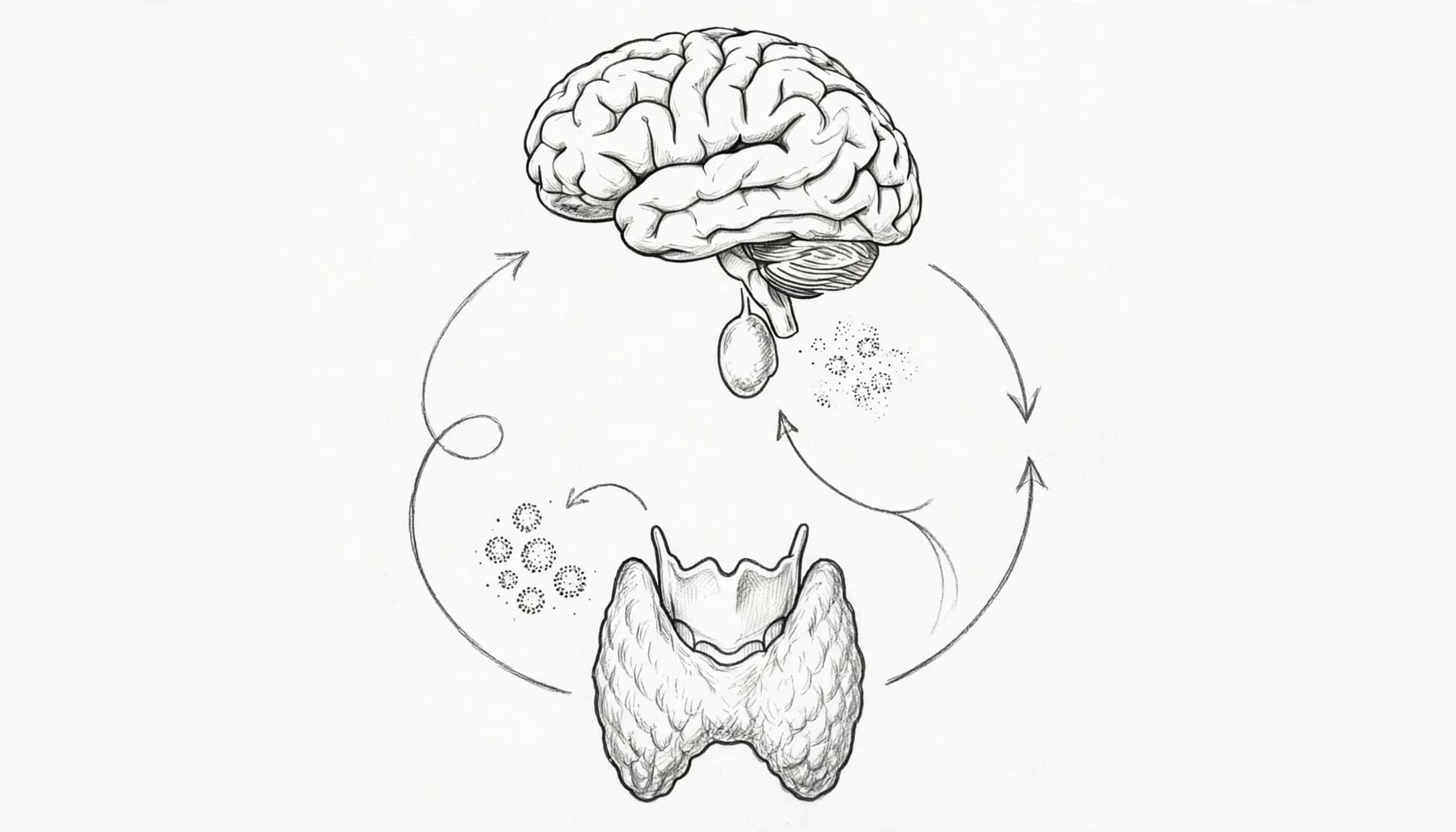
TSH is the signal to your thyroid
Thyroid-stimulating hormone, or TSH, comes from the pituitary gland at the base of your brain. It tells your thyroid to produce hormones that help regulate metabolism, temperature and energy use.
When thyroid hormone levels fall, TSH usually rises. When levels increase, it usually falls. TSH and thyroid hormone measurements are commonly assessed together in thyroid function tests.
TSH is generally the first-line screening test. Laboratories may automatically add free T4 when TSH is high, or the unbound measurement with free T3 when it's low. This is called reflex testing.
Free T4 measures available thyroid hormone
T4, also called thyroxine, is a hormone produced by your thyroid gland. Most circulates attached to proteins. Often written FT4, this measures the small unattached portion available to your tissues.
Free T4 testing helps interpret an abnormal TSH and monitor treatment. Total T4 includes both attached and unattached hormone, so it's a different measurement.
If pituitary disease is suspected, clinicians usually request free T4 alongside TSH because TSH alone can be misleading.
What are normal thyroid blood test ranges?
Reference ranges depend on the laboratory, testing method and patient group. The British Thyroid Foundation's testing guidance gives a typical adult TSH range of 0.4 to 4.0 mIU/L.
These adult examples show how intervals differ.
<table><thead><tr><th>Test</th><th>Commonly quoted adult interval</th><th>Gloucestershire Hospitals NHS interval</th></tr></thead><tbody><tr><td>TSH</td><td>0.4 to 4.0 mIU/L</td><td>0.27 to 4.2 mIU/L</td></tr><tr><td>Free T4</td><td>0.8 to 1.8 ng/dL, approximately 10 to 23 pmol/L</td><td>12.0 to 22.0 pmol/L</td></tr><tr><td>Free T3</td><td>2.3 to 4.2 pg/mL, approximately 3.5 to 6.5 pmol/L</td><td>3.1 to 6.8 pmol/L</td></tr></tbody></table>The Gloucestershire laboratory reference intervals are local examples, not universal diagnostic cutoffs. Use the interval printed beside your own result.
Different units can make equivalent results look unfamiliar. For this unbound-hormone measurement, multiply ng/dL by approximately 12.87 to obtain pmol/L. For free T3, multiply pg/mL by approximately 1.54.
These conversions apply to the same hormone measurement. They don't make free and total hormone results interchangeable.
How to read your thyroid results
Read the report in this order:
-
Identify the test, unit and laboratory reference range. FT4 and total T4 aren't interchangeable.
-
Read TSH alongside the hormone measurement; if TSH is low, look for free T3 too.
-
Consider your symptoms, medicines, recent illness and previous results before drawing conclusions.
These patterns guide clinical assessment rather than establish a diagnosis.
<table><thead><tr><th>TSH result</th><th>Free T4 or T3 result</th><th>What the pattern may suggest</th></tr></thead><tbody><tr><td>High</td><td>Low free T4</td><td>Primary hypothyroidism, an underactive thyroid</td></tr><tr><td>High</td><td>Normal free T4</td><td>Subclinical hypothyroidism</td></tr><tr><td>Low</td><td>High free T4 and/or T3</td><td>Hyperthyroidism or another cause of excess thyroid hormone</td></tr><tr><td>Low</td><td>Normal free T4 and T3</td><td>Subclinical hyperthyroidism or other influences</td></tr><tr><td>Low or normal</td><td>Low free T4</td><td>Possible pituitary-related disease, illness or medicine effects</td></tr></tbody></table>"Subclinical" describes the blood-test pattern. It doesn't mean symptoms are impossible or treatment is automatically needed.
Hypothyroidism can cause fatigue, weight gain, cold sensitivity, constipation and dry skin. Hyperthyroidism can cause weight loss, anxiety, rapid heartbeat and heat intolerance.
A slightly abnormal TSH with a normal hormone result often needs repeat testing before a lasting treatment decision.
Symptoms overlap with other conditions. Discuss the complete report with a healthcare professional rather than changing treatment yourself.
When free T3 and thyroid antibodies help
Free T3 adds detail when TSH is low
T3, or triiodothyronine, is another thyroid hormone. Your body produces much of it by converting T4.
Free T3 can identify excess hormone when TSH is low but free T4 remains within range. It isn't usually necessary for routine assessment of an underactive thyroid.
A normal T3 doesn't rule out hypothyroidism. TSH and the unbound T4 measurement usually provide more useful information for that question.
Antibodies help identify an autoimmune cause
Thyroid antibodies are immune-system proteins that can help explain why thyroid function has changed.
Anti-thyroid peroxidase antibodies, called anti-TPO, are commonly associated with Hashimoto's thyroiditis. Anti-thyroglobulin antibodies, called anti-TG or ATG, can also support an autoimmune explanation.
TSH receptor antibodies, or TRAb, help identify Graves' disease and are often elevated in that condition.
Antibodies describe a possible cause, not the amount of hormone available. Positive antibodies can occur while TSH and free T4 remain normal. Repeating antibody levels isn't usually how treatment doses are adjusted.
Preparing for thyroid blood tests
Fasting and levothyroxine timing
Standard TSH, free T4 and free T3 tests don't usually require fasting. A combined panel may require it for fasting glucose or certain cholesterol measurements. Plain water is generally allowed during a prescribed fast.
For people taking levothyroxine, a thyroid medication, blood collection before the morning dose is often preferred for consistent comparisons. Taking it shortly beforehand can temporarily raise free T4 and complicate interpretation.
Follow your prescriber's sampling plan, then take your usual dose afterward if that's the agreed schedule. Don't skip treatment for several days.
Biotin can distort the results
Biotin, also called vitamin B7, appears in many hair, skin and nail supplements. High doses can produce falsely low TSH and falsely high thyroid hormone results with some laboratory methods.
Gloucestershire's laboratory advises sampling at least eight hours after the last dose when intake exceeds 5 mg daily. Other protocols recommend stopping biotin for at least two days.
The right interval depends on the dose and assay. Tell your clinician about supplements before testing so they can set the timing. Don't stop prescribed high-dose biotin without medical advice.
Pregnancy and medicines change interpretation
Pregnancy needs its own reference ranges
Pregnancy changes thyroid physiology and the proteins carrying thyroid hormones. Results need pregnancy-specific interpretation, ideally using the laboratory's trimester-specific intervals.
During the first trimester, a TSH interval of 0.1 to 2.5 mIU/L is often quoted in older guidance. Gloucestershire lists 0.3 to 4.6 mIU/L for its first-trimester interval.
These aren't interchangeable rules. A treatment target can also differ from a diagnostic reference interval.
If you're pregnant or planning pregnancy, discuss abnormal results promptly with your maternity or prescribing clinician.
Treatment can change which result matters most
After treatment for thyrotoxicosis, meaning excess thyroid hormone, TSH can remain suppressed for many months. Free T4 and free T3 often give better information for early treatment decisions.
Amiodarone and lithium can alter thyroid function. NHS thyroid monitoring guidance recommends testing before amiodarone and every six months during treatment.
Lithium also needs baseline testing. Gloucestershire recommends at least six-monthly thyroid checks during lithium treatment. Tell the interpreting clinician about either medicine, even if you've taken it for years.
What happens after the blood sample?
Results and follow-up
A healthcare professional usually collects blood from a vein in your arm. The draw takes a few minutes; mild bruising can occur.
Gloucestershire reports a routine thyroid-test turnaround time of under 24 hours and accepts urgent requests. Timing varies between services, and antibody tests may take longer.
An abnormal result may lead to repeat testing, antibody testing, a medicine review or specialist assessment. A healthcare professional may refer you to an endocrinologist for persistent or complex abnormalities.
After a levothyroxine dose change, repeat testing commonly takes place around six to eight weeks later.
If an examination finds a goitre or thyroid nodules, a clinician may consider a thyroid ultrasound to assess the gland's structure. Imaging doesn't measure thyroid hormone function.
Recent serious illness can temporarily alter results, so an unexpected finding doesn't always mean permanent thyroid disease.
Booking thyroid testing with Bewell
Our seven-test thyroid panel includes TSH, free T4, free T3, total T4, total T3, anti-TPO and thyroglobulin antibodies. It's listed at AED 529, with home or centre visits and results in one day.
The package doesn't include TRAb. A clinician may request that separately when Graves' disease is suspected.
A broader panel isn't necessary for every routine check. Your symptoms, medical history and reason for testing should guide the selection.
Frequently asked questions
What is a dangerously high TSH level?
There's no single TSH number that defines an emergency. A persistent TSH above 10 mIU/L often prompts a treatment discussion, but free T4, symptoms, age and pregnancy affect decisions.
Severe confusion, unusual drowsiness, difficulty breathing or a very low body temperature need urgent medical attention. Seek urgent help for chest pain or severe palpitations too. Don't wait for repeat bloodwork when you're acutely unwell.
What T3 and T4 levels occur with Hashimoto's disease?
Hashimoto's doesn't have one fixed hormone pattern. Early on, TSH and free T4 can be normal despite positive antibodies.
If it causes established hypothyroidism, TSH is typically high and free T4 low. Free T3 may remain within range. Antibodies, hormone results and clinical assessment are considered together.
Understanding your results with confidence
TSH shows the signal sent to your thyroid. Free T4 shows the available hormone response. Together, they provide more useful information than either number alone.
Compare your test results with your report's own reference ranges, and record relevant medicines and supplements. Discuss abnormal findings with a healthcare professional. That gives you a sound basis for deciding whether you need monitoring, further testing or treatment.