


When we think about healthcare, we often think about doctors, hospitals, laboratories, and specialists.
But before a patient reaches any of them, there is often someone standing much closer to the community: the pharmacist.
And after the diagnosis has been made, the prescription has been written, and the patient is ready to begin treatment, there is often the pharmacist again.
This is why the pharmacist can be described as both the first and the last line of healthcare.
The First Line: Where the Healthcare Journey Begins
For many people, the pharmacy is the first place they go when something doesn't feel right.
A headache. A cough. An allergy. Stomach discomfort. A question about a medicine. A concern about a child's symptoms.
The patient may not immediately make a doctor's appointment. Instead, they walk into a pharmacy and ask:
"What should I do?"
The pharmacist becomes the first healthcare professional they encounter.
Through questions, assessment, health advice, and appropriate referral, the pharmacist can help determine whether a problem can be addressed through pharmacy care or whether the patient needs to see a doctor or specialist.
This accessibility makes pharmacy an important first line of healthcare.
But the Story Doesn't End with the Doctor
The patient may then visit a doctor, receive a diagnosis, and leave with a prescription.
But the healthcare journey doesn't end when the prescription is written.
It continues at the pharmacy.
The pharmacist is often the person who explains the medicine to the patient and helps turn a medical prescription into something the patient can safely and confidently use.
- How should it be taken?
- When should it be taken?
- For how long?
- What should the patient avoid?
- What side effects should they watch for?
- What happens if they forget a dose?
- Can it be taken with their other medications?
These questions matter.
And this is where the pharmacist becomes the last line of healthcare before treatment reaches the patient.
The Last Line: The Final Checkpoint
The pharmacist occupies a unique position in the healthcare system.
Before a patient starts taking a medicine, the pharmacist has an opportunity to review the medication, identify potential problems, clarify instructions, and make sure the patient understands the treatment.
The pharmacist can also identify situations where further clarification with the prescriber may be necessary.
Visual Flowchart: The Patient Pathway from Start Line to Finish Line
From the first question at the counter to the final medication safety check.
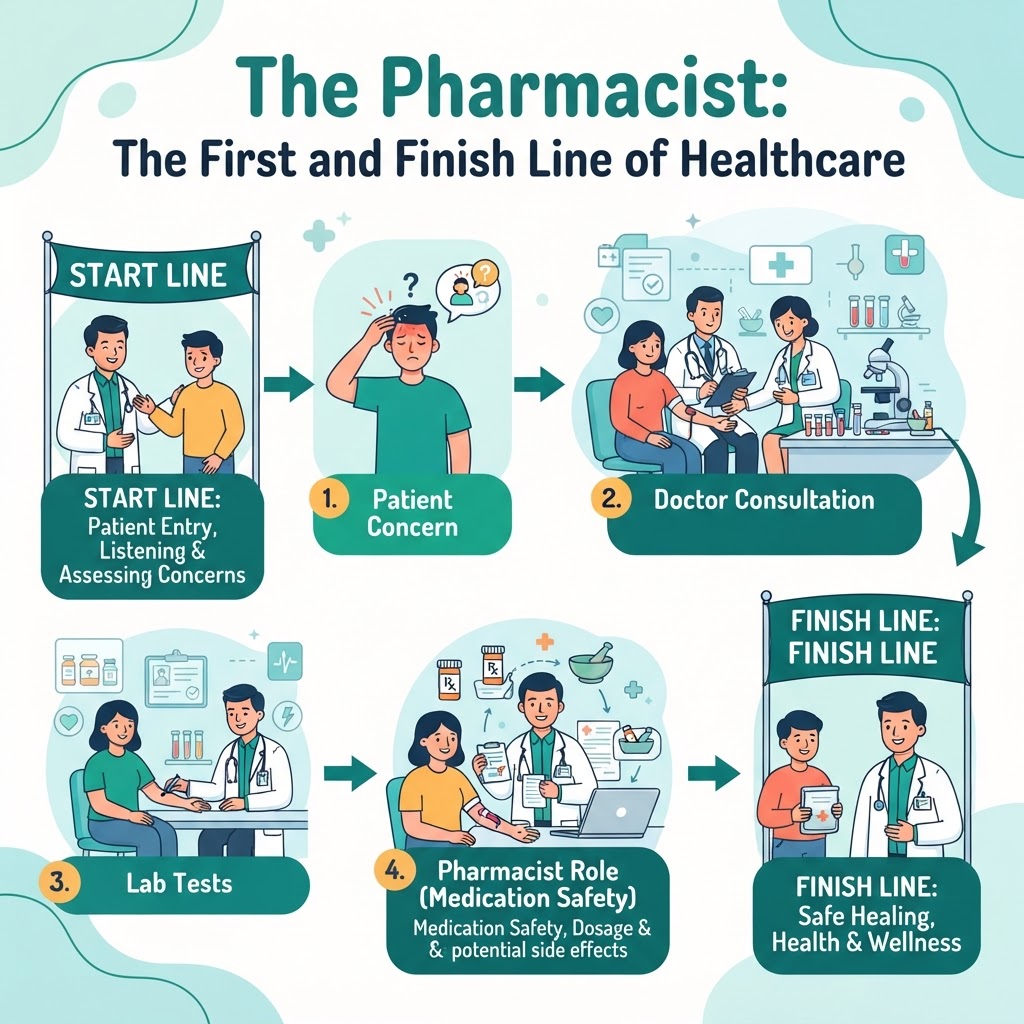
In other words, the pharmacist can serve as a final professional checkpoint between the healthcare system and the patient.
The prescription may start with the doctor. But the treatment journey often passes through the pharmacist before it reaches the patient's hands.
First Line. Last Line. One Profession.
This creates a unique circle of care:
$$\text{Patient feels unwell} \longrightarrow \text{Pharmacist initial guidance} \longrightarrow \text{Physician diagnosis} \longrightarrow \text{Pharmacist safety review} \longrightarrow \text{Safe healing}$$
- First line.
- Last line.
- And increasingly, a continuous line throughout the patient's healthcare journey.
More Than Medicines
The modern pharmacist's role extends beyond dispensing medicines. Depending on the healthcare system and scope of practice, pharmacists may contribute to vaccination, screening, chronic disease support, medication reviews, health education, prevention, and medication adherence.
This places pharmacists in a particularly important position in preventive healthcare.
They see people not only when they are sick, but also when they are looking for advice, prevention, or reassurance. A conversation at the pharmacy can sometimes be the beginning of a patient's decision to seek medical attention, undergo a screening, or take better control of their health.
Why the First and Last Line Matters
Healthcare is not simply about diagnosing disease. It is also about accessibility, prevention, education, safety, and continuity of care.
The pharmacist sits at a unique intersection of all of these:
- They are accessible to the community.
- They are trained in medicines.
- They communicate directly with patients.
- They work alongside doctors and other healthcare professionals.
- And they remain involved after the consultation is over.
That combination gives the pharmacist a distinctive role that few other healthcare professionals occupy.
The Future of Pharmacy
As healthcare continues to evolve, the pharmacist's role is also expanding. Patients are becoming more informed. Medicines are becoming more complex. Chronic diseases are increasing. Preventive healthcare is becoming more important.
All of this makes accessible healthcare professionals increasingly valuable.
The pharmacist is perfectly positioned to be part of that evolution:
- Not replacing the doctor.
- Not replacing the specialist.
- But connecting the patient to the healthcare system and helping ensure that care continues beyond the consultation room.
The first person they ask. The last person they trust.
The pharmacy may be the first place a patient goes when they have a health concern. And it may be the last healthcare stop before they begin their treatment.
That is what makes the pharmacist's position so unique. They stand at its doorway and at its final checkpoint:
The first line of healthcare. The last line of healthcare. And, for many patients, the most accessible healthcare professional in between.