


Family history can change which preventive screenings you need, when you start them, and how often you repeat them. A relative's diagnosis doesn't mean you'll develop the same condition, but it can reveal a higher-risk pattern that deserves attention.
The most useful details are the diagnosis, your relationship to that person, and their age when the condition began. Gathering those facts gives your healthcare provider a stronger basis for personalizing your screening plan.
What family history changes about screening
Routine screening recommendations usually depend on age and other established risk factors. Family history adds information that an age-based schedule alone can't capture.
Your clinician may recommend starting earlier, shortening the time between tests, or choosing a different test. For example, someone with a strong inherited breast cancer risk may need breast MRI alongside mammography. A concerning colorectal cancer history may lead to earlier colonoscopy.
However, more testing isn't automatically better. Unnecessary tests can produce false alarms and lead to procedures that carry their own risks.
Family history also reflects shared habits and environments, not only inherited genes. Your clinician considers it alongside your medical history, smoking, blood pressure, and previous results.
Our guide to personalized preventive health screening explains how regular checkups fit into ongoing prevention. The goal is to choose tests that address your risks rather than order every available test.
Build a useful family health record
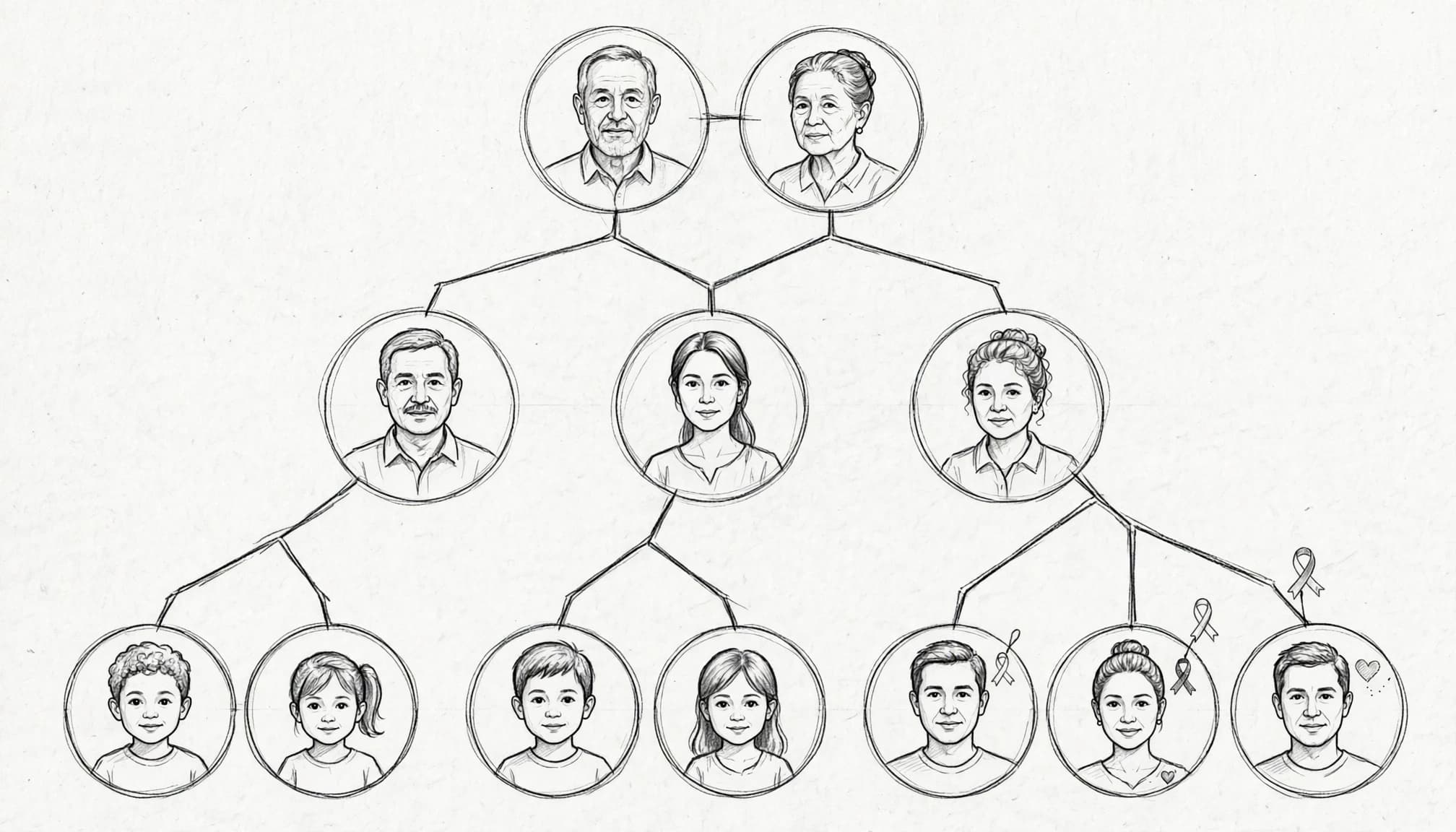
Start with biological relatives on both sides of your family. Your father's history matters just as much as your mother's, including for inherited breast and ovarian cancer risk.
Record the diagnosis and age together
Include parents, siblings, and children, who are first-degree relatives. Then add grandparents, aunts, uncles, and other biological relatives where information is available.
For each person, record the condition and age at diagnosis. Also note their current age or, if they've died, their age and cause of death.
For cancer, record where it started. Cancer that spread to the liver isn't necessarily primary liver cancer. Also include separate cancers in the same person and any known genetic test results.
The CDC's family health history guidance explains how these details help clinicians choose screening tests and timing.
Mark missing information without guessing
An approximate age is useful if that's all your relative remembers. Write "early 40s" rather than inventing an exact number.
Ask relatives privately and respect their choice about sharing information. With permission, a pathology report or genetic test report can clarify an uncertain diagnosis.
If you're adopted, donor-conceived, or have limited family contact, record those gaps. An unknown family history doesn't establish low risk. Your clinician can still use your own health information to guide prevention.
Cancer patterns that can change your plan
Young diagnoses, several affected relatives on one side, and unusual cancer combinations deserve attention. A single older relative with cancer doesn't automatically indicate an inherited syndrome.
Breast and ovarian cancer
Tell your clinician about breast cancer before age 50, male breast cancer, or ovarian cancer at any age. Pancreatic and advanced prostate cancers can also matter when assessing a possible BRCA-related family pattern.
In the United States, the USPSTF breast screening recommendation calls for mammography every two years between ages 40 and 74. That recommendation doesn't cover people with certain high-risk genetic syndromes.
A stronger inherited risk may require additional imaging and specialist planning. Meanwhile, routine ovarian screening with ultrasound or CA-125 blood testing hasn't shown a mortality benefit in asymptomatic women without a known high-risk hereditary syndrome.
Colorectal and uterine cancer
Report colorectal cancer before age 50, several affected close relatives, or a family pattern involving colorectal and uterine cancer. These can raise concern for Lynch syndrome, an inherited condition associated with several cancers.
For average-risk adults, U.S. colorectal screening recommendations start at age 45. A higher-risk family history may change the starting age, interval, and preferred test.
The exact plan depends on which relatives were affected and their ages at diagnosis. A routine blood panel can't replace colorectal screening, and a strong family pattern may require a gastroenterology or genetics referral.
Inherited risks beyond cancer
Family history can also influence cardiovascular and metabolic screening. Conditions that develop without obvious early symptoms still deserve attention.
Early heart disease and inherited cholesterol
Record heart attacks, strokes, and very high cholesterol, including the age when each occurred. Heart disease at a young age can point toward familial hypercholesterolemia, or FH, an inherited disorder that causes high LDL cholesterol.
The CDC identifies LDL cholesterol above 190 mg/dL in adults as a main sign of FH. That result requires clinical assessment; it doesn't establish the diagnosis by itself.
A family pattern may prompt earlier cholesterol testing. Our explanation of Lp(a) testing for heart risk covers another largely inherited cardiovascular risk marker.
Diabetes and related risk factors
A parent or sibling with type 2 diabetes can affect your clinician's decision about when to assess blood sugar. They also consider weight, previous pregnancy-related diabetes, and other risk factors.
Screening may involve HbA1c, which reflects average blood sugar over roughly three months, or fasting glucose. Family history doesn't mean everyone needs every test annually.
If you already have diabetes or high cholesterol, repeat testing monitors an established condition. That schedule differs from screening someone without a diagnosis.
Turn your history into a written screening plan

Bring a one-page summary to your appointment, along with previous screening dates and results. Put the youngest diagnoses and known inherited conditions near the top so they're easy to identify.
Your clinician can then combine your family history with your age, health, and applicable screening guidance. International recommendations provide useful reference points, but they aren't automatically a UAE-wide schedule.
Ask for a written plan that states each recommended test, its purpose, the next due date, and who will review the result. Also establish whether you need a specialist referral before testing.
A normal blood panel doesn't replace a mammogram or colonoscopy when either is due.
Once a clinician has identified appropriate blood tests, we offer home sample collection across the UAE and in-center visits. That convenience supports testing, but screening doesn't replace a physician's examination.
If you have symptoms, tell your clinician rather than waiting for your next preventive appointment. A breast lump, rectal bleeding, or unexplained weight loss needs assessment even after a recent normal screening result.
When genetic counseling belongs in the plan
Genetic counseling helps you understand whether your family pattern suggests an inherited condition and whether testing could change your care. It doesn't mean you definitely have a harmful gene change.
A counselor reviews the family history, explains possible results, and discusses implications for biological relatives. When possible, testing often starts with a relative who has had the relevant cancer because their result may be more informative.
The National Cancer Institute's guidance on cancer genetics risk assessment describes this process.
A harmful variant in BRCA1 or BRCA2 can lead to a specialist prevention plan. Lynch syndrome also requires condition-specific care.
However, a negative result doesn't always remove the risk suggested by family history. Its meaning depends partly on whether the family already has an identified harmful variant. A "variant of uncertain significance" means the effect is unclear; it shouldn't independently drive major preventive decisions.
Update the plan when family history changes
Family history is an ongoing record. A sibling's new diagnosis or a relative's genetic result can change the information behind your original plan.
Use these steps to keep it useful:
-
Add each new diagnosis, the relative's age at diagnosis, and any available genetic findings to your record.
-
Share significant changes with your clinician promptly, especially a young cancer diagnosis or confirmed inherited condition.
-
Ask whether the change affects your next test date, test type, or need for specialist assessment.
Review the record during routine preventive appointments too. Keep the updated screening schedule somewhere you can retrieve it, alongside your results.
If testing identifies an inherited condition, relatives may benefit from targeted assessment. A genetics professional can help explain what information to share without assuming everyone needs the same tests.
Key Takeaways
-
Record diagnoses and ages at diagnosis on both sides of your biological family.
-
Family patterns may change screening timing or test choice, but they don't automatically justify extra testing.
-
Keep a written plan and update your clinician when a relative develops a relevant condition or receives a genetic result.
Frequently Asked Questions
Does no family history mean I can skip screening?
No. Many cancers and chronic conditions occur in people without an affected relative. Continue recommended age-based screening unless your clinician advises a different plan. A small family, early deaths, or missing information can also hide a pattern, so describe those gaps.
Should I order genetic testing because one relative had cancer?
One diagnosis doesn't automatically justify testing. The cancer type, age at diagnosis, and wider family pattern matter. Genetic counseling can help determine whether testing is useful and which family member should be tested first. Choosing a broad panel without that context may produce confusing results.
Keep Prevention Matched to Your Risk
The strongest screening plan combines your own health information with an accurate, updated family history. A relative's diagnosis is a reason to reassess risk, not a prediction of your future.
Start with the details you know and bring them to your next preventive visit. A written screening plan turns those details into clear decisions about what you need and when.