


For accurate home blood pressure readings, use a validated upper-arm monitor, rest quietly for five minutes, then take two readings one minute apart. Correct cuff fit and consistent technique help you avoid misleading results.
A rushed measurement, unsupported arm or small cuff can change the numbers your healthcare professional uses to guide care. Home monitoring supports diagnosis and treatment, but it doesn't replace medical appointments.
Start with the right equipment and follow the same routine each time you measure blood pressure at home.
Choose a validated home blood pressure monitor
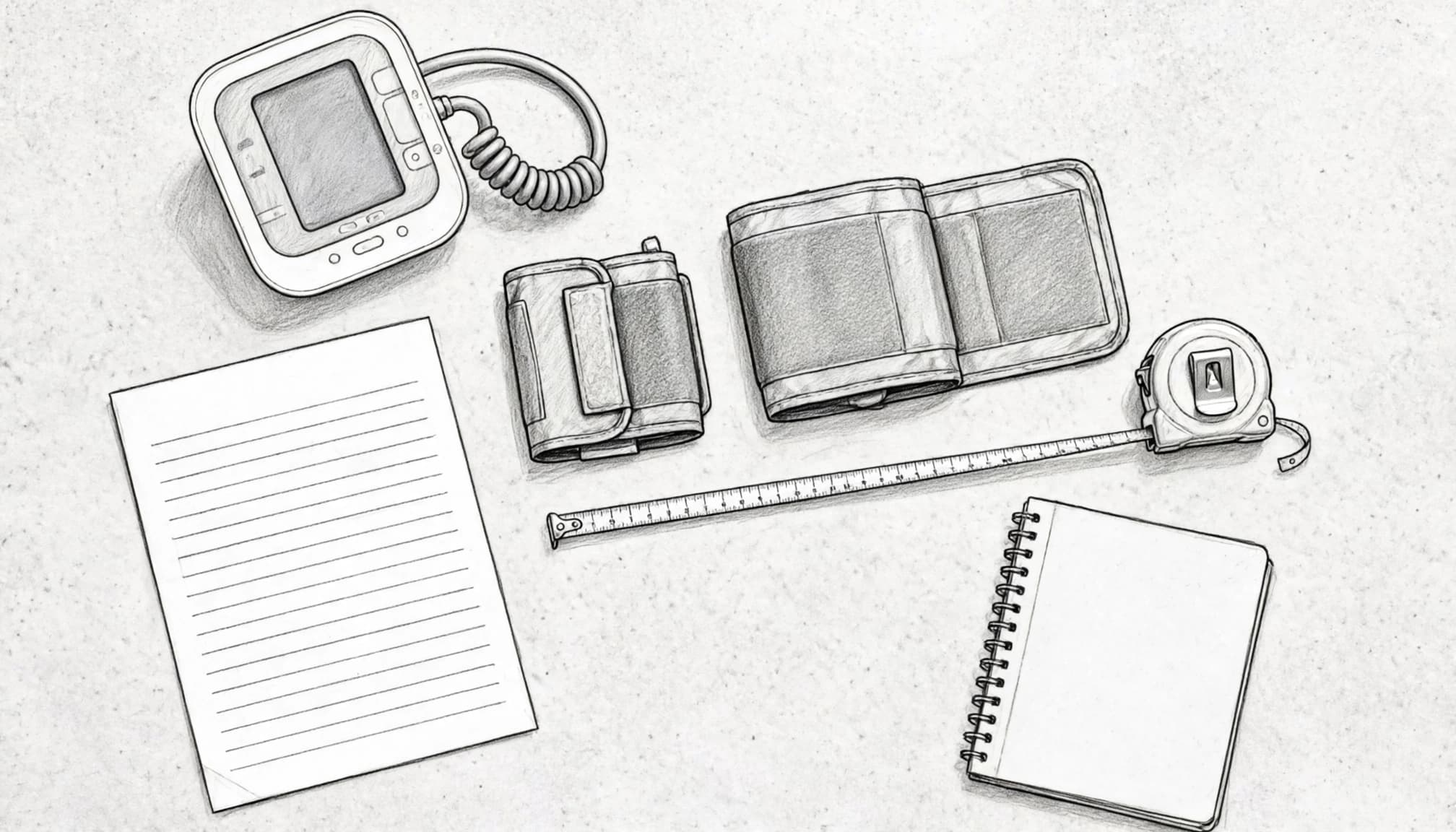
Choose an automatic upper-arm device
The American Heart Association's monitoring guidance recommends an automatic, cuff-style upper-arm monitor. Wrist and finger monitors are less reliable because their readings are more sensitive to position.
Choose a validated monitor listed in the ValidateBP directory. Validation means validated devices have passed an accepted accuracy-testing process.
Older studies reported inaccuracies in 72% of 554 automated devices in 2009 and 24% of 382 devices in 2011. These historical samples don't describe every monitor sold today, but they support choosing validated equipment rather than relying on advertising.
Match the cuff to your arm
Measure around the middle of your upper arm with a tape measure. Choose a cuff size whose printed circumference range includes that measurement.
Traditional standard cuffs suit many adults, but arms under 24 cm or over 32 cm need an appropriately sized cuff. Modern wide-range cuffs have different limits.
The inflatable bladder inside the cuff should cover approximately 80-100% of the arm's circumference. You don't need to measure the bladder yourself. The manufacturer's stated arm-size range, not appearance or a generic label, determines cuff size.
A cuff that's too small can overestimate blood pressure. One that's too large can underestimate it.
Take an accurate reading, step by step
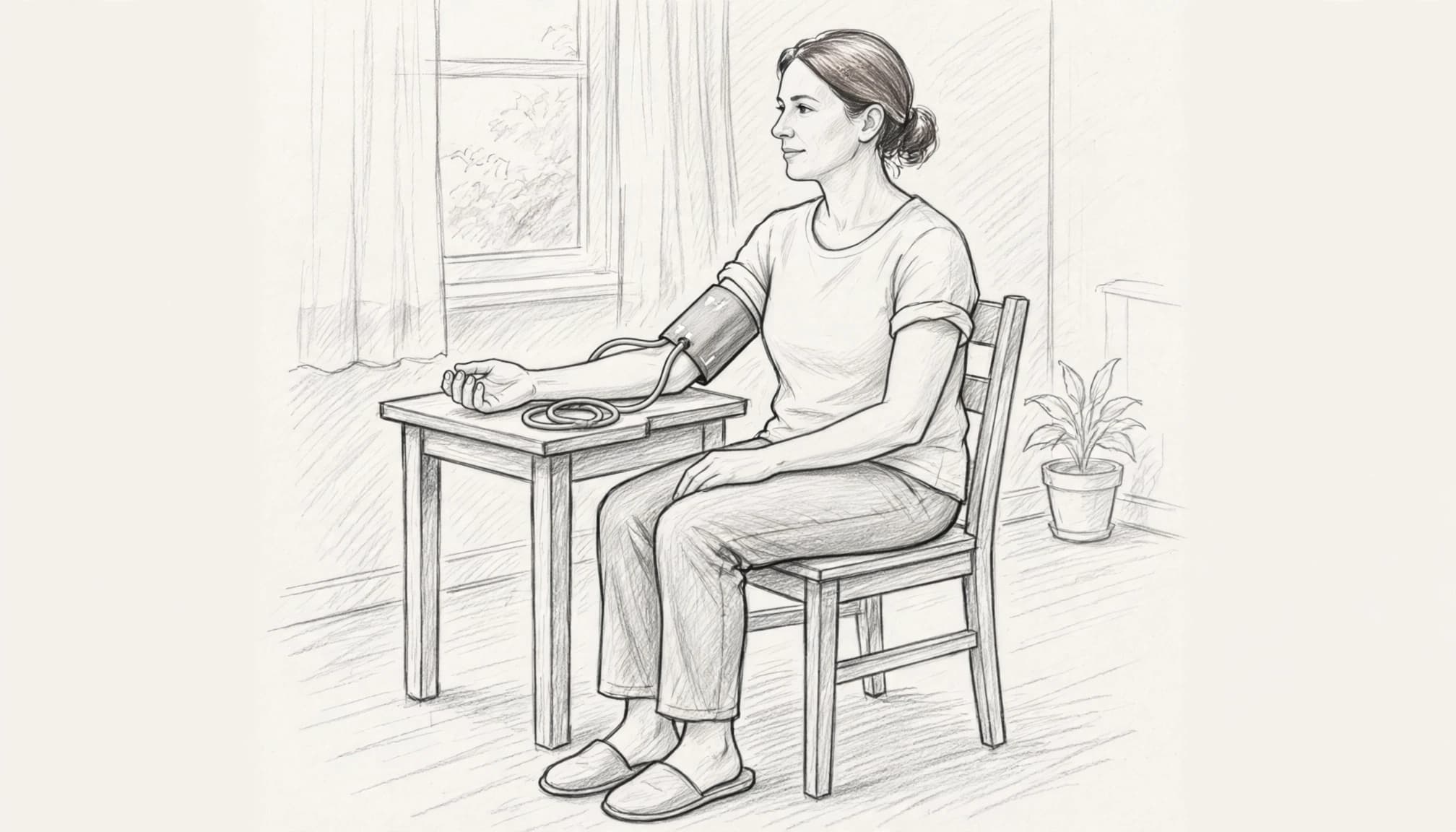
Follow this sequence for every blood pressure reading session:
-
Prepare beforehand. Avoid smoking, caffeinated drinks and exercise for at least 30 minutes. Empty your bladder before sitting down.
-
Settle into position. Sit in a chair with your back supported and both feet flat on the floor. Keep your legs uncrossed. Rest quietly for at least five minutes without talking or using your phone.
-
Fit the cuff. Place it on bare skin, with its bottom edge directly above the elbow bend. Follow the cuff's positioning marks and fastening instructions. Don't measure over clothing or roll a tight sleeve above it.
-
Support your arm. Rest your forearm on a table or cushion so the middle of the cuff sits at heart level. Relax your hand and shoulder. Don't hold your arm up using muscle effort.
-
Measure twice. Start the monitor and remain still and silent. Wait at least one minute after the first reading, then repeat. Record both results.
The AHA's illustrated measurement instructions show the recommended arm position and cuff placement.
Use the same arm for ongoing measurements, following your healthcare professional's advice. If you're helping someone, arrange their chair and arm support before the quiet rest period begins. Avoid conversation while the cuff inflates.
Build a useful measurement schedule and log
Measure morning and evening
Take readings at consistent times rather than only when you feel stressed or unwell. Blood pressure often causes no symptoms, so how you feel isn't a dependable guide.
For a diagnostic home blood pressure monitoring (HBPM) period, NICE recommends two consecutive seated readings, at least one minute apart, twice daily. Measure morning and evening for at least four days, ideally seven.
Discard the first day's readings when calculating the average. Keep those results in your original log, however, so your healthcare professional can review them.
A review of home monitoring schedules supports averaging readings across several days rather than interpreting one session alone. Your clinician may recommend a different schedule for ongoing treatment monitoring.
Record enough detail to explain the numbers
Use a notebook, spreadsheet or blood pressure journal to record your results. Include the date, time and both readings, including the top and bottom numbers.
Also note medication timing, symptoms and unusual circumstances, such as pain, missed medication or an interrupted measurement. These details can explain an unexpected result.
With a seven-day schedule, excluding day one leaves 24 readings. Calculate the systolic and diastolic averages separately: add each set of numbers, then divide by 24.
Don't delete a result simply because it's higher than expected. Instead, mark any technique problem beside it.
Recognize errors and differences between settings
Small technique mistakes can change readings
Talking, crossed legs and a full bladder can raise a reading. An unsupported back or arm can also distort the result.
If the cuff sits below heart level, the reading may be too high. Above heart level, it may be too low. Measuring through clothing or immediately after walking upstairs adds further uncertainty.
Correct the setup before repeating an unexpected measurement. Don't keep taking readings until you get a number you prefer.
Keep both scheduled readings. Selecting only the lowest result can hide a pattern your healthcare professional needs to see.
Home and clinic readings won't always match
Home readings are usually lower than office readings and closer to averages recorded during 24-hour ambulatory blood pressure monitoring, or ABPM. ABPM uses a wearable cuff that measures throughout the day and night.
A European Cardiology Review article describes office readings varying by as much as 30 mmHg over two weeks without treatment changes. That finding describes observed variability, not an expected difference for everyone.
White-coat hypertension means pressure is high in the clinic but lower outside it. Masked hypertension means the reverse. Reviews have reported each pattern in roughly 10-15% of patients with hypertension, although estimates vary by setting.
Home records can reveal these patterns and inform a clinician's assessment of cardiovascular risk, but they don't establish a diagnosis on their own. A clinician confirms the diagnosis and may recommend ABPM.
Understand the top and bottom numbers
The top number, systolic pressure, measures pressure when your heart beats. The bottom number, diastolic pressure, measures pressure between beats. Both use millimetres of mercury, written as mmHg.
The AHA's blood pressure classification uses these categories:
<table><thead><tr><th>Category</th><th>Systolic, top number</th><th>Diastolic, bottom number</th></tr></thead><tbody><tr><td>Normal</td><td>Below 120</td><td>And below 80</td></tr><tr><td>Elevated</td><td>120-129</td><td>And below 80</td></tr><tr><td>Stage 1 hypertension</td><td>130-139</td><td>Or 80-89</td></tr><tr><td>Stage 2 hypertension</td><td>140 or higher</td><td>Or 90 or higher</td></tr><tr><td>Severe hypertension</td><td>Above 180</td><td>And/or above 120</td></tr></tbody></table>When the systolic and diastolic numbers fall into different rows, the higher blood pressure category applies. A normal bottom number doesn't cancel out a high top number.
These categories explain readings, but they don't establish a diagnosis from one measurement. Diagnostic thresholds and treatment targets can differ between guidelines and measurement settings. Your healthcare professional interprets your multi-day home average alongside your health history.
Respond safely to a very high reading
One high reading doesn't automatically mean an emergency. Stay calm, remain seated and consider whether the preparation or positioning was incorrect.
If systolic pressure is above 180 mmHg or diastolic pressure is above 120 mmHg, wait at least one minute and measure again. These thresholds are commonly written as 180/120 mm Hg. If it remains that high without symptoms, contact a healthcare professional immediately. Don't wait until your routine appointment.
Seek emergency help immediately if a very high reading comes with chest pain, shortness of breath, back pain, weakness, numbness, vision changes or difficulty speaking. Don't delay emergency care to complete your log or take repeated measurements.
In the UAE, call 998 for an ambulance. In the US, call 911. These symptoms can require emergency assessment even without a very high reading.
Don't take extra blood pressure medication unless a clinician has given you a clear plan for doing so.
Share your log and monitor at your appointment
Bring the complete record, your calculated average, and a list of medications and supplements. Include the dates covered and which arm you used.
If your clinic offers telemonitoring, which lets you share readings remotely, confirm its preferred format. Otherwise, bring a clear digital export instead of scattered screenshots. Keep individual readings so your clinician can assess patterns as well as the average.
Bring your monitor and cuff too. A healthcare professional can review your technique, assess cuff fit, and compare your device's results with clinic equipment.
When broader assessment is appropriate, our hypertension checkup includes blood pressure assessment alongside kidney, lipid, blood sugar, and electrolyte testing. Screening supports clinical care, but doesn't replace a physician's examination or confirm hypertension by itself.
Key takeaways for reliable readings
-
Use a validated upper-arm monitor with a cuff that fits your measured arm circumference.
-
Follow the same preparation, posture and two-reading routine each time.
-
Share the complete record, including unusual readings and symptoms, rather than only your preferred numbers.
Frequently asked questions
Is 140 over 70 normal?
Under AHA categories, 140/70 meets the stage 2 systolic criterion because the top number is 140. The lower number of 70 doesn't make the whole reading normal.
Repeat it with correct technique and record both measurements. If this pattern continues, arrange a medical review. One reading alone doesn't confirm hypertension.
Can I stop medication when home readings improve?
Don't stop or reduce prescribed medication on your own. Improved readings may mean the treatment is working.
Continue the prescribed plan and share your results with your clinician. If readings become unusually low or you feel dizzy, faint or unwell, seek medical advice rather than adjusting the dose yourself.
Make consistency the basis of your monitoring
Reliable home blood pressure monitoring depends on repeatable technique and a complete record. A properly fitted cuff and an unhurried routine make your results more useful.
Prepare your measurement space, follow the agreed schedule and bring the full log to your appointment. Let your healthcare professional use the pattern to guide diagnosis and treatment.