


A coronary artery calcium score measures calcium-containing plaque in your heart's arteries and helps clarify your future heart disease risk. Clinicians use it alongside cholesterol, blood pressure and other risk factors to discuss preventive treatment.
When you're unsure whether to start cholesterol-lowering medication, interpret the result alongside your other risk factors. It doesn't show every form of atherosclerotic material. Understanding what the scan measures is the first step toward making sense of your number.
Key takeaways
-
A CAC scan detects calcium deposits, but it doesn't measure the percentage of artery blockage.
-
Zero calcium usually means lower near-term risk, although noncalcified plaque can still be present.
-
The test is most useful when its result could change a prevention decision.
What a coronary calcium scan measures
A coronary artery calcium (CAC) scan, also called a coronary calcium scan, is a low-dose CT scan (computed tomography). It detects calcium deposits in the coronary arteries, which supply blood to your heart muscle. Some deposits in the coronary arteries calcify over time, creating the calcium buildup detected by the scan.
Calcium reveals established plaque
Deposits contain cholesterol and other substances that build up within artery walls. Over time, some deposits become calcified.
The American Heart Association's CAC explanation describes how greater calcium amounts generally indicate more coronary artery disease. However, calcium scoring doesn't directly measure blood flow or show how tightly an artery has narrowed.

How the Agatston score works
Introduced in 1990, the Agatston method identifies calcified deposits and combines their number, area and density. Density depends on peak Hounsfield units, a CT measurement of how strongly tissue absorbs X-rays.
The total produces your calcium score. Some systems also calculate calcium volume or mass, but most patient reports use Agatston units. The number isn't a percentage or a cholesterol measurement.
How to read your coronary artery calcium score
Scores start at zero and can exceed 400, sometimes reaching well above 1,000. Higher values generally indicate a greater calcified burden and higher risk of coronary artery disease.
University of Iowa Health Care (UIHC) publishes these simplified bands.
<table><thead><tr><th>UIHC's published score range</th><th>General interpretation</th></tr></thead><tbody><tr><td>0</td><td>No detectable coronary calcium</td></tr><tr><td>0 to 100</td><td>Low risk</td></tr><tr><td>100 to 300</td><td>Moderate risk</td></tr><tr><td>300 and above</td><td>Very high risk</td></tr></tbody></table>These published bands overlap at their boundaries. Other reporting systems use different cutoffs, so your clinician interprets the exact result rather than relying on a category alone.
A report may also give an age- and sex-based percentile. The 75th percentile means your calcium burden exceeds that of roughly 75% of comparable people. It doesn't mean you have a 75% chance of a heart attack.
Because calcium becomes more common with age, the same score can carry different significance in a younger and older adult.
Who should consider a CAC scan?
The strongest reason to consider CAC testing is uncertainty about preventive treatment in someone without cardiovascular symptoms.
Cigna's decision aid says people at intermediate risk, often described as medium risk, benefit most. It describes testing as generally unhelpful at low or high risk, because treatment decisions may already be clear.
UIHC describes typical candidates as adults aged 40 to 60 with moderate risk and no cardiovascular symptoms. Its service requires a cardiologist appointment first; that isn't a universal referral rule.
Age also affects usefulness. Cigna notes that men under 40 and women under 50 may be less suitable candidates because younger arteries often contain little calcium. Younger adults with inherited risk still deserve assessment, but blood tests and family history may offer more useful information.
Older ACCF/AHA criteria focused on asymptomatic adults with a 10-year coronary heart disease risk of 10% to 20%. They didn't recommend routine CAC testing below 10% or above 20%. Those historical categories shouldn't be confused with newer risk calculators and guidance.
A CAC scan isn't an emergency test. Chest pain or severe breathlessness needs urgent medical assessment, regardless of any previous calcium score.
What happens during the scan
A dedicated coronary calcium scan usually doesn't require injected contrast dye or an intravenous line. The process is straightforward:
-
You lie on a table, and the team places ECG electrodes on your chest to monitor your heartbeat.
-
The table moves through the CT scanner while you briefly hold your breath.
-
Software measures calcium deposits, and a clinician reviews the images and report.
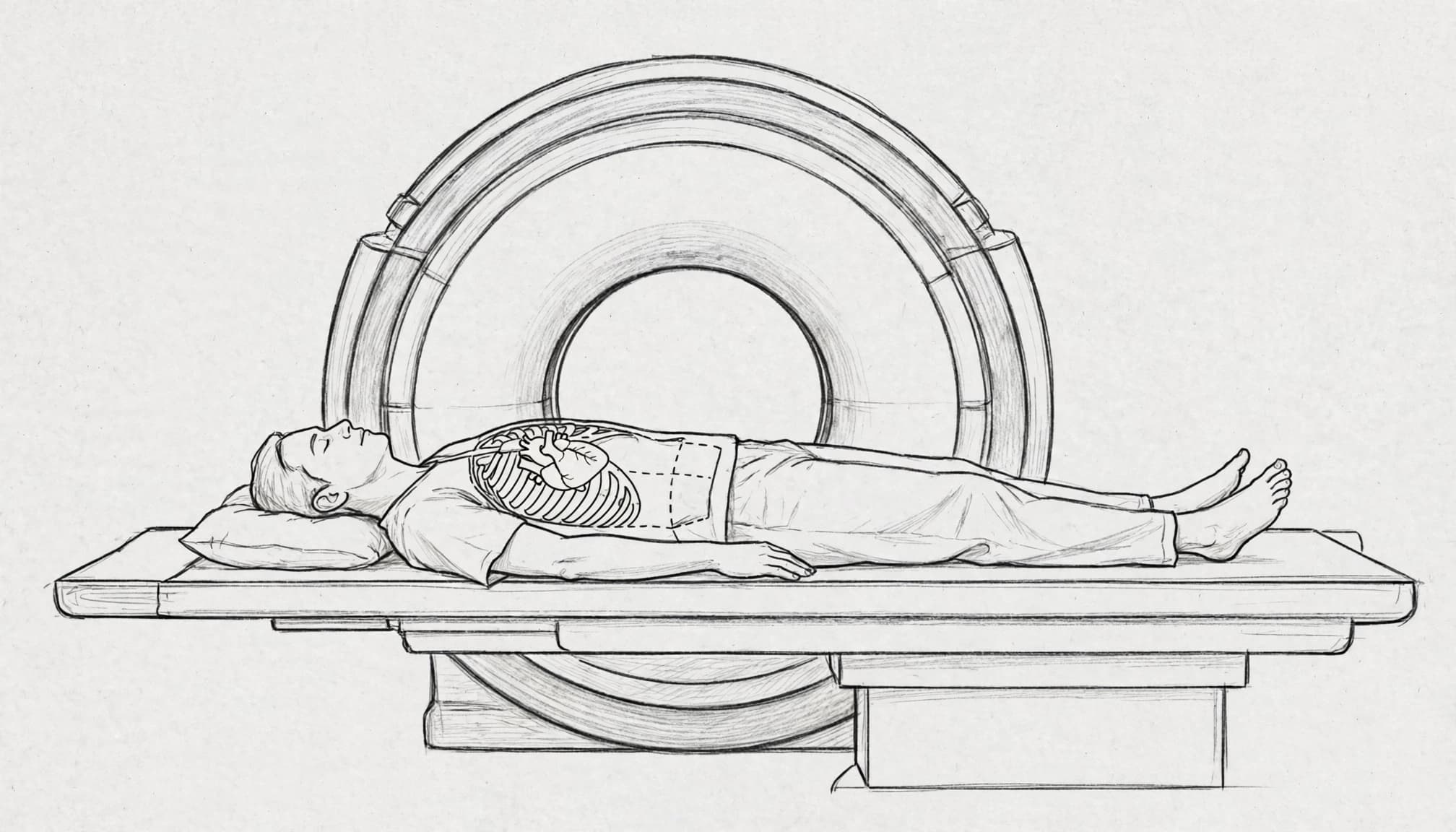
UIHC estimates about 15 minutes for the visit, while Cigna describes approximately 30 minutes. Image acquisition itself is brief, and people generally resume normal activities afterward.
Tell the imaging team if you're pregnant or might be pregnant, because the scan uses X-rays.
How the result guides preventive treatment
Your clinician combines CAC findings with your overall risk profile and other risk factors. Blood pressure, smoking, diabetes, cholesterol levels and a family history of early heart attacks all matter.
What a score of zero can change
Zero means the scan found no detectable calcified plaque in the coronary arteries. In an otherwise suitable person, this may support postponing cholesterol-lowering medication after a shared discussion.
It doesn't rule out early, noncalcified deposits. Smoking, diabetes, very high LDL cholesterol or a strong family history can still support treatment despite zero calcium.
Over the next five years, a zero score generally indicates lower heart-attack risk, but it cannot provide a personal guarantee. Healthy habits and lifestyle changes still matter, along with management of existing risk factors.
A zero calcium score doesn't cancel a separate reason to treat high cardiovascular risk.
What a positive score adds
Detectable calcium strengthens the case for prevention. Clinicians commonly discuss statins, particularly with scores of 100 or more or a high age-adjusted percentile.
The 2026 dyslipidemia guideline summary supports selective CAC use when lipid-lowering decisions remain uncertain.
Blood testing adds different information. Standard lipid panels don't include inherited lipoprotein(a), or Lp(a). Our advanced lipid profile checkup includes Lp(a) and apolipoprotein measurements that can support a broader risk discussion.
A positive score doesn't automatically mean you need aspirin, an angiogram or a stent. Aspirin requires a separate assessment of cardiovascular benefit and bleeding risk.
Radiation, measurement limits and further testing
CAC testing carries a small cancer risk from radiation exposure. It can also reveal incidental findings or trigger further testing that doesn't improve outcomes.
Modern doses differ from older CT figures
A multicenter radiation study reported average CAC exposure of approximately 1 millisievert (mSv).
By contrast, a 2008 review cited 6.4 to 11.0 mSv for older 16- and 64-slice cardiac CT studies, compared with a mean 5.6 mSv for diagnostic catheter angiography. Those historical cardiac-imaging figures shouldn't be treated as the typical dose of a modern dedicated calcium scan.
That review also reported Agatston variability of about 3% between readers, under 1% for the same reader, and approximately 15% between scans. Small score changes therefore don't necessarily prove meaningful disease progression.
Historical thresholds aren't automatic treatment rules
The 2008 clinical review reported Pletcher's pooled adjusted odds ratios for coronary events: 2.1 for scores of 1 to 100, 5.4 for 101 to 400, and 10 above 400. These are relative associations, not personal event probabilities.
It also described Moser and colleagues' threshold above 400 for initiating myocardial SPECT, a nuclear blood-flow test. Scores below 100 were very unlikely to accompany abnormal SPECT findings in that research.
These older findings don't mean every high score requires stress imaging. Symptoms and the clinical question should guide additional testing.
What a calcium scan costs
Cigna's calcium scan decision guide gives a US price range of approximately $100 to $400 and says most health insurance plans don't cover it.
That is US guidance, not a UAE price or coverage statement. A dedicated ECG-gated calcium scan is also different from a routine chest CT or full-body CT, so those services aren't interchangeable.
The useful starting point is a clinical risk assessment, followed by a discussion about whether CAC would change your prevention plan.
Common questions about calcium scores
Is a calcium score of 6 good?
Six indicates a small amount of calcified plaque. It's low compared with scores in the hundreds, but it still shows that coronary atherosclerosis is present.
Age and percentile matter. A score of 6 in a younger adult may deserve more attention than the same result later in life. It should prompt a prevention discussion rather than reassurance that risk has disappeared.
Is a calcium score of 1,100 good or bad?
A score of 1,100 indicates extensive coronary calcification and high cardiovascular risk. It deserves a timely discussion about intensive prevention and any symptoms.
However, it doesn't mean an artery is 100% blocked or that a heart attack is imminent. People can have substantial plaque without symptoms or an abnormal blood-flow test, because plaque burden and flow-limiting narrowing measure different things.
What is an average calcium score for a 75-year-old?
There's no single average that can tell a 75-year-old whether their result is acceptable. Calcium becomes more common with age, but common doesn't mean harmless.
Clinicians interpret the absolute score alongside an age- and sex-based percentile, overall health and treatment goals. That combination is more useful than comparing your result with an isolated age-based number.
Use the score to inform a prevention plan
A coronary artery calcium score adds evidence about calcification burden when a treatment decision remains uncertain. Its strongest use is helping you and your clinician choose an appropriate prevention plan.
Consider the result alongside your cholesterol measurements, blood pressure and family history. The aim is to reduce future cardiovascular risk, rather than focus on the scan number alone.