


The Cooper test estimates aerobic fitness by measuring how far you can run or walk in 12 minutes. Your distance can also produce an estimated VO2 max, a useful fitness measure that isn't a medical diagnosis.
The test is simple to administer, but pacing, course accuracy, and the scoring table you choose all affect how you interpret the result. Here's how to prepare, record your distance, calculate the estimate, and compare it with age and sex norms.
What the Cooper test measures
A 12-minute field test
Dr. Kenneth H. Cooper designed the 12-minute run test in 1968 for use with U.S. military personnel. Participants cover as much distance as possible in exactly 12 minutes on a flat, measured course. The original study compared field-test distances with treadmill measurements of maximal oxygen uptake. Cooper Institute's history of the 12-minute run describes the test's development and early validation.
The result reflects cardiovascular endurance, but it also depends on running economy, pacing, motivation, weather, and course conditions. As a result, the Cooper test works best for comparing your performance with your own earlier results under similar conditions.
What your result tells you
The test produces two related but distinct results: distance covered and an estimated VO2 max. VO2 max, or maximal oxygen uptake, estimates how much oxygen your body can use during intense exercise relative to body weight.
A longer distance generally corresponds to a higher estimate. However, the formula predicts a value from a field test. It doesn't measure oxygen uptake directly, as a laboratory test can.
How to prepare and run the test safely
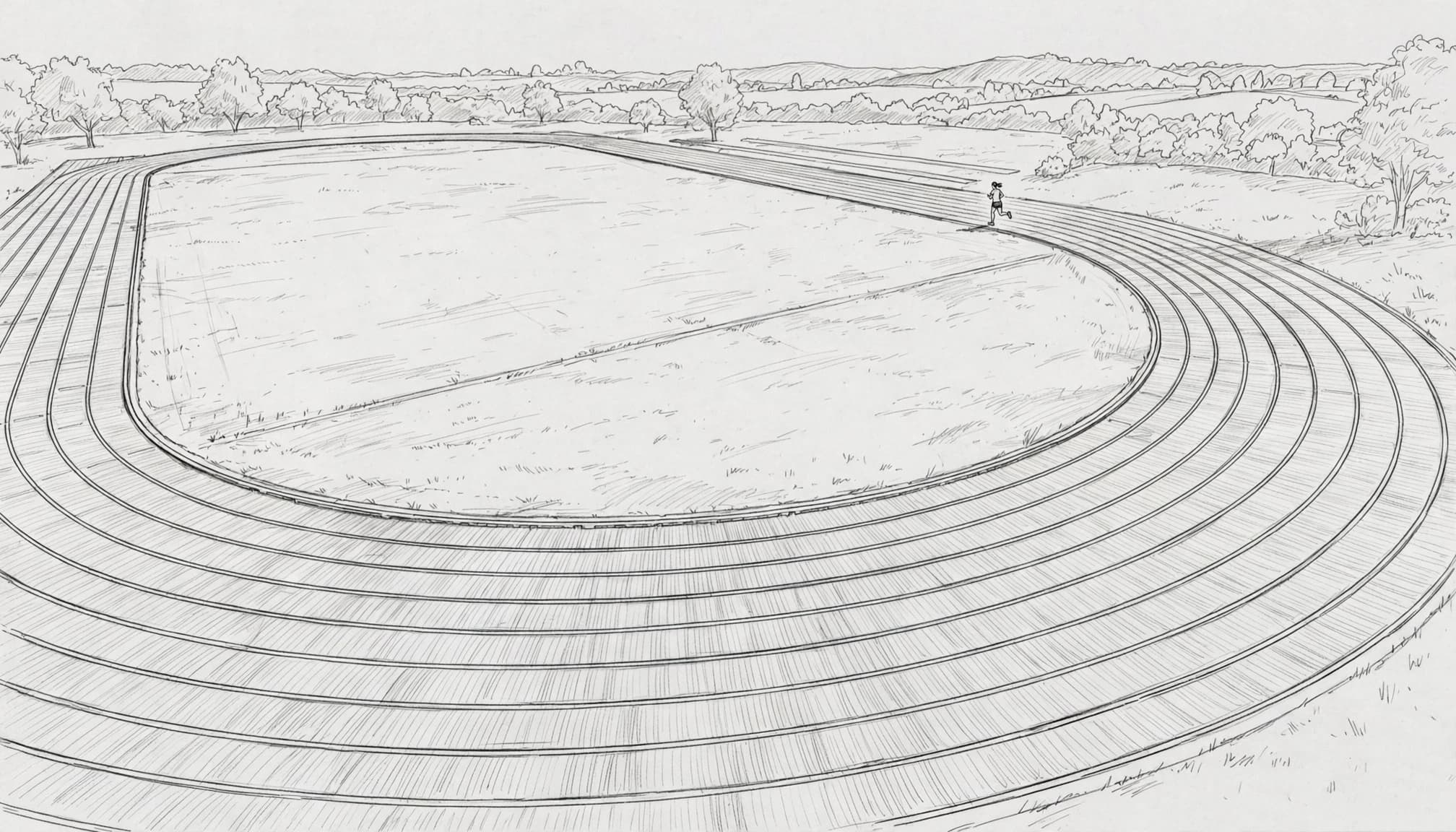
Choose a consistent course
A standard 400 meter track is a good choice, especially if you stay in lane 1. A flat, accurately measured course also works. Avoid steep hills, sharp turns, and crowded paths, since they can change your pace or make distance harder to measure.
Wear familiar running shoes and test in mild weather when possible. If you're comparing results over time, use the same course and similar conditions. Record the surface and weather so you can account for differences later.
Warm up and pace evenly
Warm up before the clock starts. A 10- to 15-minute warm-up can include easy jogging and dynamic movements. Guidance varies, but a short, gentle warm-up is better than starting cold, particularly before a hard effort.
Use a pacing strategy built around an even, sustainable hard effort, not a sprint. Many runners go out too fast and slow sharply in the final minutes. Hold a steady pace, then increase it in a controlled way if you still have energy near the end.
Start the stopwatch and cover as much distance as possible during the full 12 minutes. When time expires, note your position immediately. Walk slowly for several minutes to cool down. Stop if you experience chest pain, dizziness, or unusual shortness of breath. If you have a medical condition that affects exercise, ask a health professional whether a maximal test is appropriate.
Measure your distance and estimate VO2 max
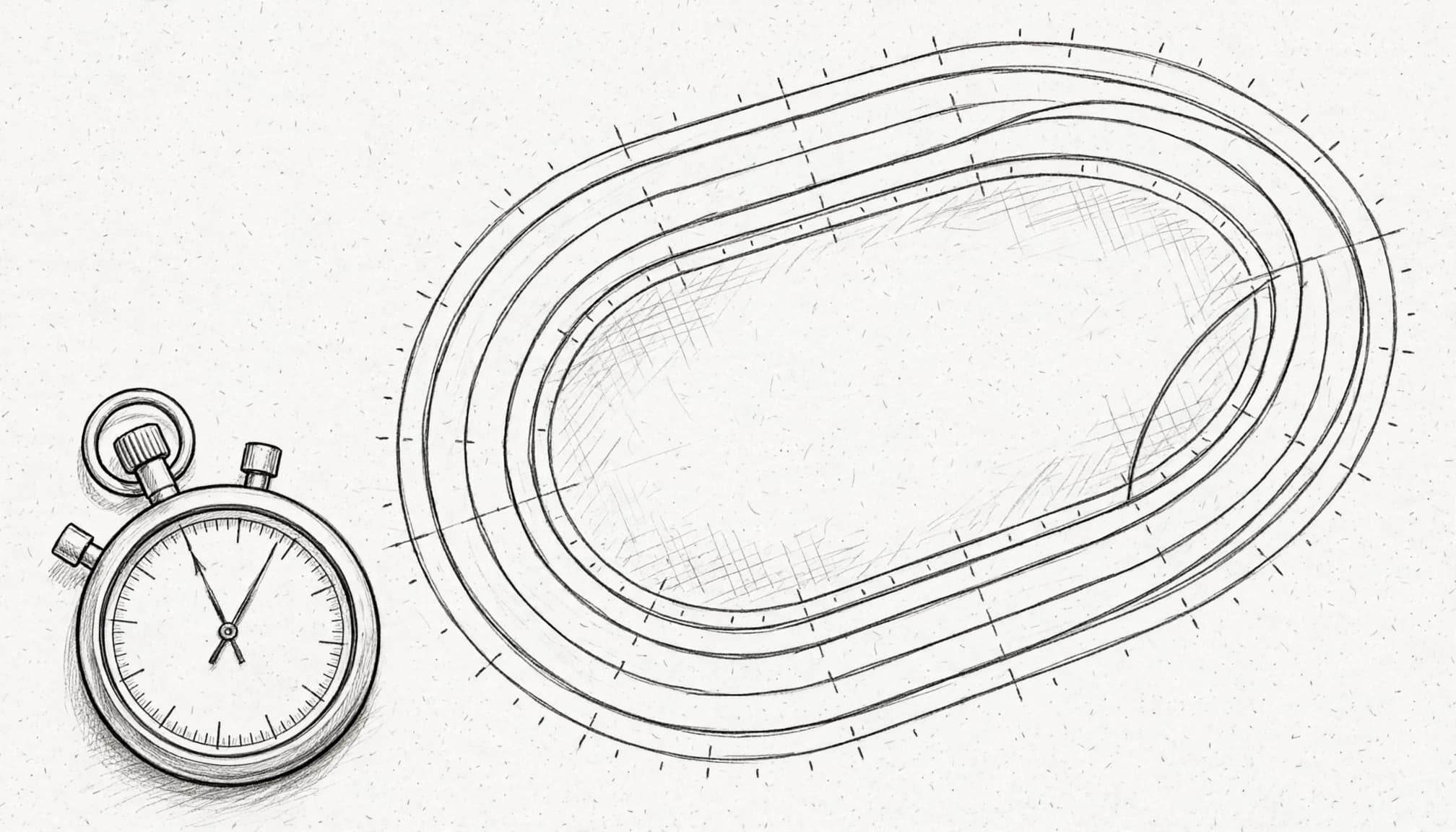
Count full laps and the final portion
On a 400-meter track, four full laps equal 1,600 meters. Keep a lap counter or ask someone to record each lap, then measure the partial lap at the end. For example, four laps plus 200 meters equals 1,800 meters.
A GPS watch can help, but its distance may differ from a measured track, especially around curves or when the signal is weak. Treat the course measurement as the reference when precision matters. For a better comparison next time, repeat the test on the same track and in the same lane.
Use the 12-minute formula
A VO2 max calculator can apply this equation. Enter distance in meters and treat the result as an estimate:
Estimated VO2 max = (distance in meters - 504.9) / 44.73
For a distance of 2,400 meters:
(2,400 - 504.9) / 44.73 = 42.4 ml/kg/min
That result is an estimate in milliliters of oxygen per kilogram of body weight per minute. Research on the Cooper test has found that its accuracy can differ across groups. For example, a validation study in male university students examined how well the test predicted VO2 max in its particular sample. A result from one study population shouldn't be treated as a guarantee of precision for every runner.
Keep the 1.5-mile test separate
The 1.5 mile run is an adaptation with a fixed distance and a timed result. It is not the standard 12-minute test, which fixes the time and records distance.
One formula used for the 1.5-mile variant is:
VO2 max = (483 / time in minutes) + 3.5
For a 12-minute 1.5-mile run, the estimate is 43.75 ml/kg/min. Use the equation and scoring standards designed for the test you completed. Don't apply the 12-minute distance formula to a timed 1.5-mile result.
Interpret Cooper test norms carefully
Norms depend on the source
Age and gender norms compare your distance with a reference group. Check how each table defines its categories, since this article uses sex-based categories. Norms don't change the distance you ran or the VO2 max formula, but they can change your performance label.
Tables can differ because they use different samples, age bands, and rating cutoffs. Normative standards vary by source, so the same distance can receive a different fitness rating. A table called "Cooper norms" isn't automatically an official Cooper Institute table. Check the source and the specific age and sex category before interpreting a label such as "excellent."
Example thresholds for ages 20 to 29
The following cutoffs illustrate how tables vary. They are thresholds, not a complete set of ratings for every score.
<table><thead><tr><th>Source and group</th><th align="right">Excellent</th><th align="right">Very poor</th></tr></thead><tbody><tr><td>Boxrox, men ages 20 to 29</td><td align="right">Over 2,800 m</td><td align="right">Under 1,600 m</td></tr><tr><td>Testsforsports, men ages 20 to 29</td><td align="right">Over 2,911 m</td><td align="right">Under 1,915 m</td></tr><tr><td>Boxrox, women ages 20 to 29</td><td align="right">Over 2,700 m</td><td align="right">Under 1,500 m</td></tr></tbody></table>For a man ages 20 to 29, 2,400 meters falls below the listed "excellent" thresholds, but these figures alone don't establish a precise middle rating. Use the full table from one source rather than mixing cutoffs from different tables. A score also isn't a diagnosis or a measure of overall health.
How reliable is the Cooper test?
A practical estimate, not a lab measurement
The Cooper test is convenient because it needs little equipment and can test a large group at once. That makes it useful in schools, sports programs, and fitness assessments. However, motivation and running technique affect how much distance a participant covers, so two people with similar aerobic capacity may not perform identically.
The original research reported a strong relationship between 12-minute distance and treadmill-measured VO2 max. A correlation describes how two measures vary across a study group. It doesn't guarantee that an individual's field estimate will match laboratory VO2 max testing.
Why another test may give a different answer
The Astrand cycle test uses a cycle ergometer and estimates aerobic capacity through a different exercise mode. A Cooper test score and an Astrand estimate shouldn't be treated as interchangeable. Cycling experience, running ability, effort, and the specific estimation method can all affect the outcome. The Beep Test uses audio cues to increase shuttle-running speed, so its result isn't directly comparable with a fixed-time distance result.
A study comparing Cooper's 12-minute run with treadmill testing found no statistically significant difference between the mean predicted and measured VO2 max in its sample, while a separate step test produced lower estimates. That result doesn't establish equal accuracy for every person. A PubMed-indexed reliability and validity study offers further context on how field-test results compare with laboratory measurements.
Treadmill use and other adaptations
Can you do the test on a treadmill?
Yes, you can run for 12 minutes on a treadmill, but the result may not match an outdoor track test. Treadmill calibration, belt speed, incline, and running conditions can affect the distance and effort. Record the machine and settings if you plan to repeat the test.
A 1% incline is sometimes suggested to approximate the energy cost of outdoor running. Evidence for that setting comes from a small study of trained male runners and short running bouts, so it doesn't prove that every treadmill user should use 1% for a 12-minute test. In either setting, use the norms and formula that match the version you performed.
Group testing and the 2.4-kilometer run
The 12-minute format is easy to administer to a group because participants share a start time while each person records their own distance. That's one reason schools and sports teams use it for fitness testing.
A 2.4-kilometer run is another timed-distance format. The Singapore Football Association adopted the 2.4-kilometer run as a mandatory fitness test from 2013. Because it fixes distance rather than time, it remains distinct from the standard Cooper test, even when people use similar endurance measures to assess performance.
Key takeaways
-
Run or walk as far as possible in exactly 12 minutes on a flat, measured course.
-
Warm up, start at a sustainable hard pace, and record full laps plus the final partial lap.
-
Use (distance in meters - 504.9) / 44.73 to estimate VO2 max from the standard test.
-
Choose one age and sex norm source, since rating thresholds can vary.
-
Treat the result as a fitness estimate, not a medical diagnosis.
Use the score as a baseline
A Cooper test gives you a practical snapshot of aerobic fitness, but the number depends on more than heart and lung capacity. Course accuracy, pacing, motivation, and the scoring source all matter.
Use the result as a baseline and compare future tests under similar conditions. A consistent change over time is usually more informative than a single rating from a table.