


The ANA blood test, also called an ANA test, checks for antinuclear antibodies that can help identify autoimmune conditions. A positive result alone doesn't establish a diagnosis.
Your doctor interprets it alongside your symptoms, examination and other tests. Understanding the result starts with why it was ordered and how the laboratory reports it.
Key takeaways
-
A positive ANA can occur in healthy people.
-
Titers and patterns guide follow-up but don't confirm disease.
-
Symptoms determine whether further testing or rheumatology referral is useful.
Why doctors order an ANA blood test
An antinuclear antibody (ANA) is an immune protein that reacts with structures inside your body's cells, particularly the nucleus. These antibodies are what the test detects. The ANA screening test is an ANA test that helps investigate suspected connective tissue disease or systemic autoimmune disease.
Doctors may request it for persistent joint swelling, unexplained rashes, mouth ulcers, dry eyes or mouth, or muscle weakness.
Conditions considered include systemic lupus erythematosus (SLE), Sjögren's syndrome, scleroderma, rheumatoid arthritis and polymyositis. Rheumatoid factor and anti-CCP are more useful when rheumatoid arthritis is suspected.
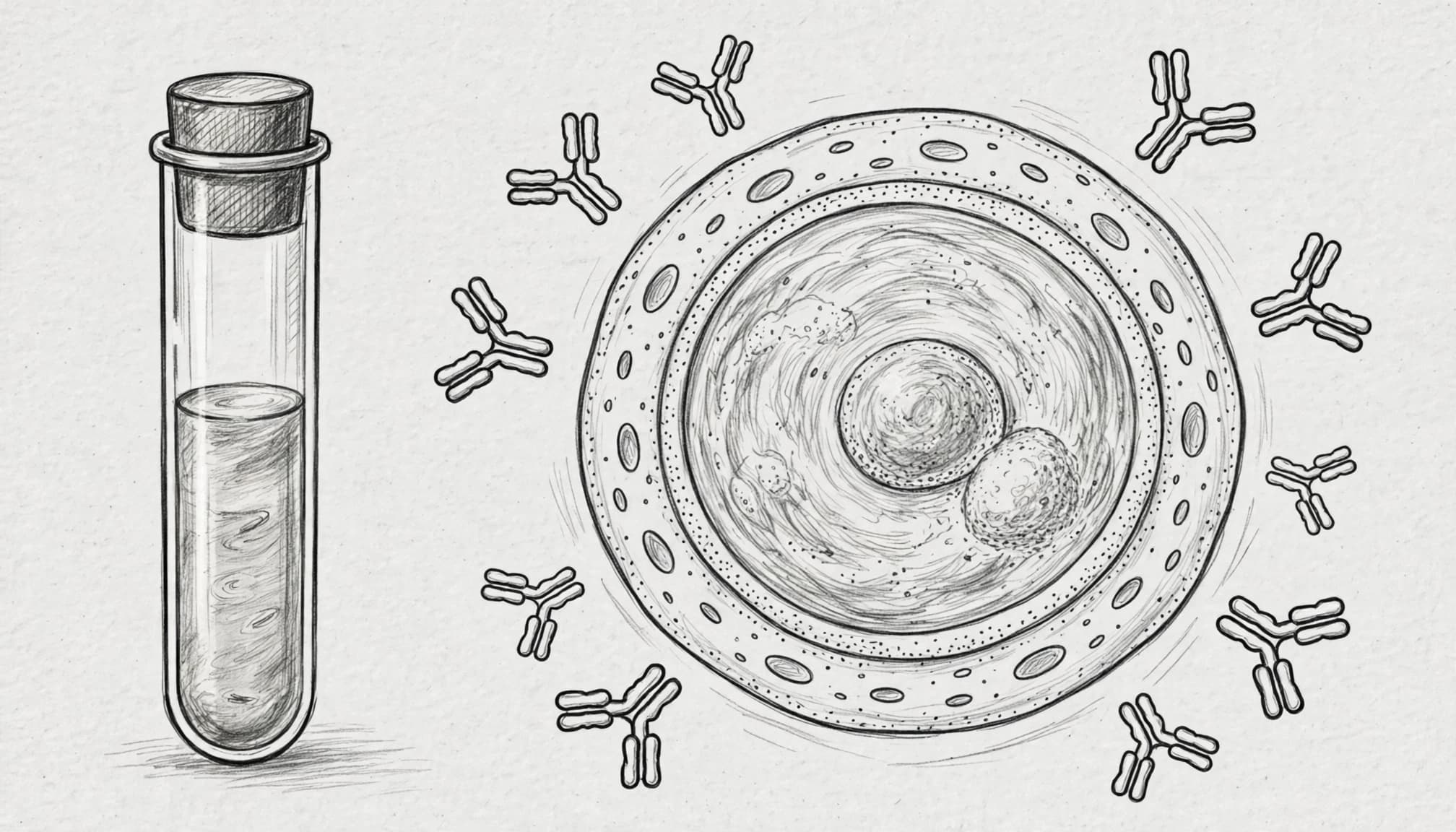
The test needs a small blood sample. ANA testing alone usually doesn't require fasting, although other tests collected together may.
Does a positive ANA mean autoimmune disease?
Over 95% of people with SLE test positive, yet most ANA-positive people don't have SLE. More than one-third of people with rheumatoid arthritis may also test positive.
Around one in six otherwise healthy people can show this immune system activity and receive a positive test result. Reported rates range from 15% to 30%, depending on the method and cutoff. Positivity is more common in older adults and women.
A "false positive" result means antibodies were detected without evidence of the suspected disease. It doesn't necessarily mean the laboratory made an error.
Infections, Hashimoto's thyroiditis, liver disease including hepatitis, and some medicines for high blood pressure, heart disease or tuberculosis can cause positivity. Don't stop prescribed medicines without medical advice.
Understanding ANA titers and patterns
What 1:80 and 1:640 mean
Indirect immunofluorescence (IIF), often performed using HEp-2 cells, usually begins at a dilution of 1:40 or 1:80. The titer is the last dilution where antibodies remain detectable.
A titer of 1:640 stays positive after more dilution than 1:80. Higher titers raise suspicion when symptoms fit. A 1:640 result doesn't mean disease is eight times more severe than a 1:80 result.
In a Mariz et al. study, 45.8% of ANA-positive healthy controls had a 1:80 titer. Among ANA-positive patients with autoimmune rheumatic diseases, 88.5% had titers of at least 1:320.

What staining patterns suggest
The six basic International Consensus on ANA Patterns (ICAP) nuclear patterns are homogeneous, speckled, dense fine speckled, centromere, discrete nuclear dots and nucleolar.
Homogeneous can occur with lupus; speckled with lupus or Sjögren's. Centromere and nucleolar patterns can suggest scleroderma. Discrete nuclear dots can occur with autoimmune liver disease, including primary biliary cholangitis.
An isolated, confirmed anti-DFS70 antibody associated with a dense fine speckled (DFS) pattern generally lowers suspicion for systemic autoimmune rheumatic disease. It doesn't exclude disease by itself.
Why the testing method matters
Sensitivity and specificity describe how well a method detects people with the target disease and identifies those without it. One cohort summarized by the Association for Diagnostics & Laboratory Medicine reported these results:
<table><thead><tr><th>Method</th><th>Sensitivity</th><th>Specificity</th></tr></thead><tbody><tr><td>IIF, 1:40 cutoff</td><td>94%</td><td>43%</td></tr><tr><td>IIF, 1:80 cutoff</td><td>84%</td><td>62%</td></tr><tr><td>EIA</td><td>74%</td><td>80%</td></tr><tr><td>MIA</td><td>67%</td><td>87%</td></tr></tbody></table>These cohort-specific figures aren't your personal probability of disease. Raising the IIF cutoff reduced false positives but missed more affected patients.
EIA means enzyme immunoassay; MIA means multiplex immunoassay. EIA and MIA test selected targets, so their antigen specificity depends on which antigens are included; IIF reports staining patterns. IIF also shows a titer. EIA usually gives a numerical value; MIA often reports positive or negative. Laboratory cutoffs vary.
What happens after a positive ANA?
Follow-up tests depend on symptoms
Follow-up antibodies may include anti-double-stranded DNA (anti-dsDNA), SS-A, SS-B, Sm, Scl-70, Jo-1, RNP, anti-ribosomal P and anti-centromere. Not everyone needs the full panel.
Doctors may add a complete blood count, creatinine/eGFR, urine protein testing, complement C3/C4 and inflammation markers such as CRP or ESR. These assess blood cells, kidney function and inflammation.
Our Super Bewell checkup includes ANA and anti-CCP. These tests answer different clinical questions and need interpretation alongside your symptoms.
Referral and treatment follow the findings
Your primary care doctor may refer you to a rheumatologist, a specialist in arthritis and autoimmune disease.
There's no treatment for a positive ANA alone. Treatment targets any diagnosed condition. Regular exercise, good sleep, avoiding tobacco and reducing alcohol support general health; they aren't proven ways to lower ANA.
Frequently asked questions
Can you have lupus with a negative ANA?
A negative ANA result makes lupus much less likely, although rare cases occur. Persistent symptoms still need assessment because ANA doesn't detect every autoimmune condition.
What if I have no symptoms?
An isolated positive result usually doesn't require treatment or repeated ANA testing. Your doctor can review the titer, medicines and medical history, then decide whether follow-up is needed.
Put your ANA result in context
The most useful interpretation connects your ANA result with clinical findings, rather than treating the number alone.
Bring your report, symptom history and medicine list to your appointment. That gives your doctor the information needed to decide whether further testing, monitoring or specialist care is appropriate.